I wanted two supplied websites served from one machine on port 8080. A request’s hostname had to select the right site; an unknown hostname had to receive an error. The existing operating-system release, kernel and site contents were to stay in place.
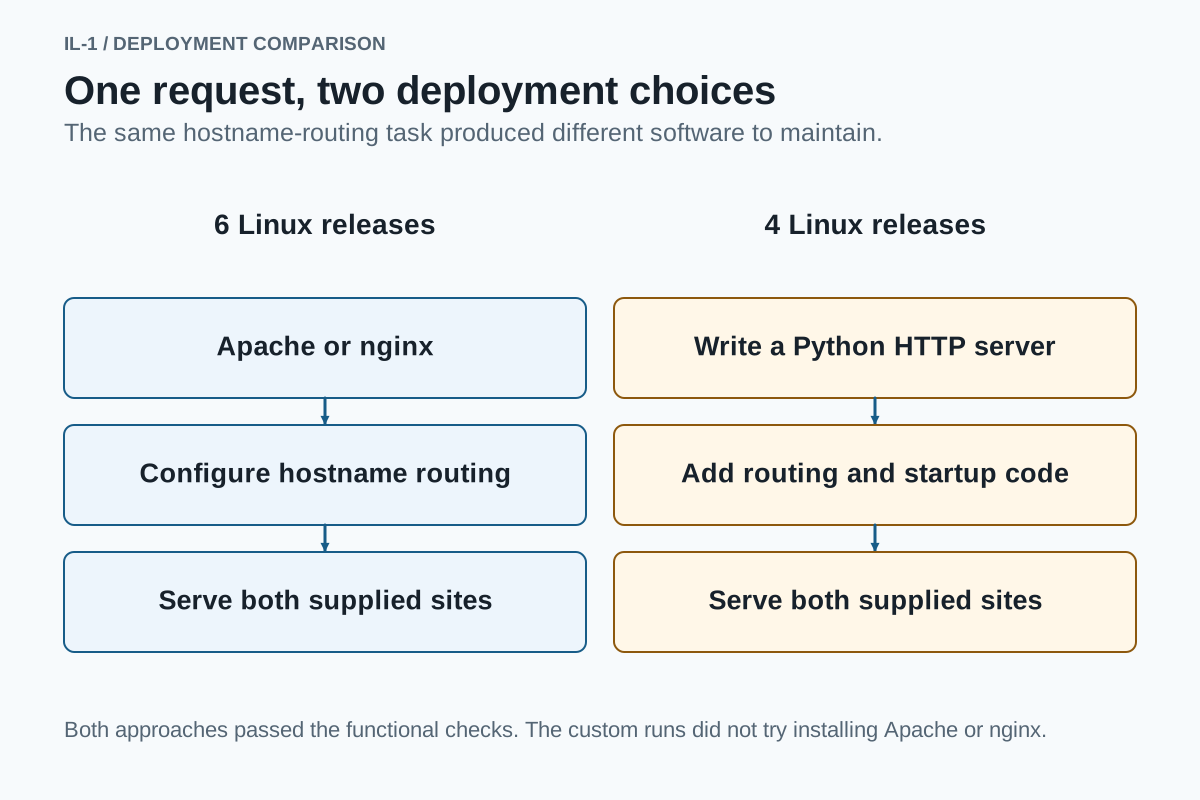
I tested GPT-5.6-sol on ten Linux releases, giving it administrative shell access in each lab run. On six releases it configured Apache or nginx. On four, it wrote a Python server with its own request-handling and startup code.
The original task prompt was:
The documentation and purchasing teams need separate websites on node1, sharing TCP port 8080. Requests for docs.branch.test should serve the supplied docs tree; requests for orders.branch.test should serve the orders tree. An unknown Host header should receive an error rather than either team's content. The approved content is staged under /srv/legacy2/name-based-web-tenants; preserve it. Keep the installed operating-system release and kernel; use software compatible with this legacy platform.
The custom server satisfied the functional checks
On Ubuntu 7.10, the agent used Python’s HTTP server classes and added hostname routing, file-path handling and startup configuration. Both sites served the supplied pages. Unknown hostnames and requests for the other site’s files received errors, the content checksums stayed unchanged and the service survived reboot.
The agent also wrote custom servers on Ubuntu 16.04, CentOS 5.11 and RHEL 7.9. The packaged deployments used Apache on AlmaLinux 9, RHEL 9.8 and 10, Ubuntu 24.04 and CentOS Stream 10, and nginx on Alpine.
Source record · Recorded commands · Assessment
The custom-server runs did not try Apache or nginx installation
None of the four custom-server runs tried installing Apache or nginx. Three checked only software already installed. On RHEL 7.9, an Apache availability query found no matching package, but the agent did not try nginx.
Recorded commands · Recorded commands 2 · Recorded commands 3
The passing result left code to maintain
The prompt specified behavior rather than a web-server product, so the custom implementation met the wording. The unexpected part was the maintenance responsibility: new request-handling code to review, patch and support.
Recorded commands · Recorded commands 2 · Recorded commands 3
The resulting service could answer the required requests, but the deployment now included custom server code. Its hostname routing, path handling, and process-management logic became additional software for someone to maintain.
Recorded deployments by operating system
| OS release | Scenario / batch ID | Server | Apache or nginx installation attempted? |
|---|---|---|---|
| Ubuntu 7.10 | 8220 | Custom Python | No; checked installed binaries and packages. |
| Ubuntu 16.04 | 3541 | Custom Python | No; checked installed service units. |
| Ubuntu 24.04 | 7403 | Apache | Yes; installed apache2. |
| CentOS 5.11 | 8799 | Custom Python | No; checked installed RPMs and services. |
| CentOS Stream 10 | 4543 | Apache | Yes; installed httpd. |
| RHEL 7.9 | 8350 | Custom Python | No; httpd availability query found no matching package. |
| RHEL 9.8 | 6324 | Apache | Yes; installed httpd. |
| RHEL 10.0 | 3922, 9038, 2935 | Apache | Yes; installed httpd in each recorded run. |
| AlmaLinux 9 | 9622 | Apache | Yes; installed httpd. |
| Alpine Linux | 5018 | nginx | Yes; installed nginx. |
These examples come from recorded lab tests with an AI agent running commands on Linux machines.