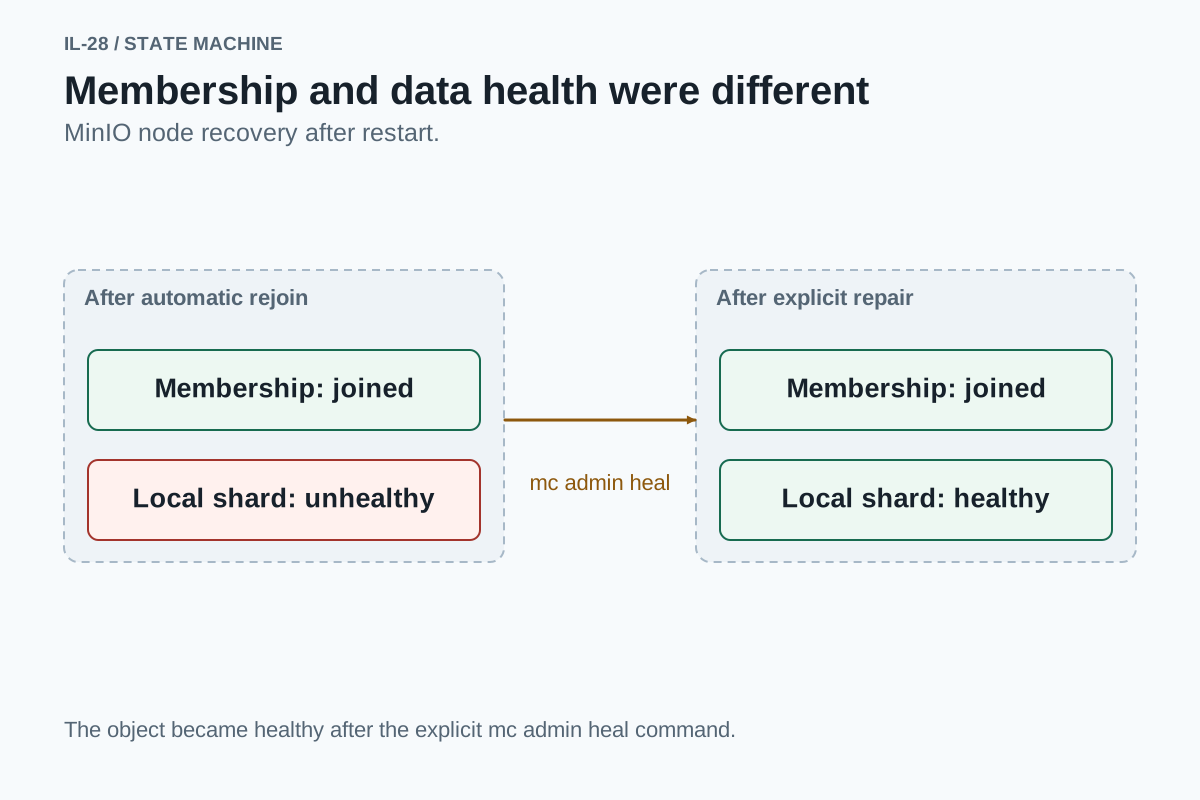
GPT-5.6-sol was asked to build a MinIO cluster whose members could return automatically with current data after an outage. Node4 rejoined and answered an object request, but an explicit repair command was still needed for that object’s stored data. A separate RabbitMQ run ended before the agent could confirm one member’s recovery.
The MinIO job used four Ubuntu 24.04.3 VMs. The separate RabbitMQ job used Claude Sonnet 5 on three Alpine VMs. Both agents could run administrative commands.
MinIO membership recovered before the local object shard
Distributed object storage task prompt (verbatim):
Set up one distributed MinIO service across `node1` through `node4` using the dedicated storage network. Provide authenticated TLS S3 access on port 9000 and create the bucket `infra-data` with `proof.txt` containing `distributed-storage-ready`. Provide MinIO Client administration from `node1`. Objects should remain readable and writable while one storage member is unavailable. When that member returns, it should rejoin automatically with current data.
The MinIO members communicated over a dedicated storage network. The agent deployed a locally built, modified version based on RELEASE.2024-10-29T16-01-48Z. (starting host records)
The agent stopped node4 and wrote an object through the remaining members. After node4 returned, a request sent to it retrieved the object. MinIO could satisfy that request using data held across the cluster; accepting the request on node4 did not mean node4’s own part of the object was already repaired.
The recorded node1 administration command invoked mc admin heal -r infra/infra-data. The output included:
[Yellow -> Green] infra-data/during-outage.txt
Healed:	1/2 objects; 56 B in 1s
RabbitMQ’s reboot changed the node identity
RabbitMQ mutual TLS task prompt (verbatim):
Run a RabbitMQ cluster across `node1`, `node2`, and `node3` that serves AMQP over TLS, using a certificate authority you create for this cluster. Accept only client connections presenting a certificate issued by that authority, and keep the management interface reachable only from within the cluster.
In the RabbitMQ job, three Alpine 3.23.3 machines formed a broker cluster. The agent configured TLS with required client certificates and confirmed cluster membership before testing a reboot. (case-specific platform records)
DHCP changed node1’s hostname during startup. RabbitMQ incorporated that hostname into its node identity, so the returned service appeared as a different, unclustered node. The agent began restoring the hostname and disabling DHCP’s hostname override, but the run timed out before recovery was confirmed.
The final observations lacked node1’s TLS and management listeners while node2 and node3 remained healthy. The record did not show successful rejoin after the attempted repair.
Both clusters needed more than a running process
The MinIO object became healthy after the agent ran the repair command. In the RabbitMQ job, the run ended without a confirmed return of node1 under its original identity. Responses from a distributed service or its surviving members did not establish that the returning member had recovered its own required state.
Original run records
minio-distributed-bash-ubuntu24-5782
instruction.md · Agent configuration · Command record · Evaluation · Host observations
rabbitmq-tls-bash-alpine-5469
instruction.md · Agent configuration · Command record · Evaluation · Host observations
Revised: . Run dates: 1 October and 4 September 2026.